Bitcoin Is For You: The Daily Bit
365 Days to Understanding Bitcoin
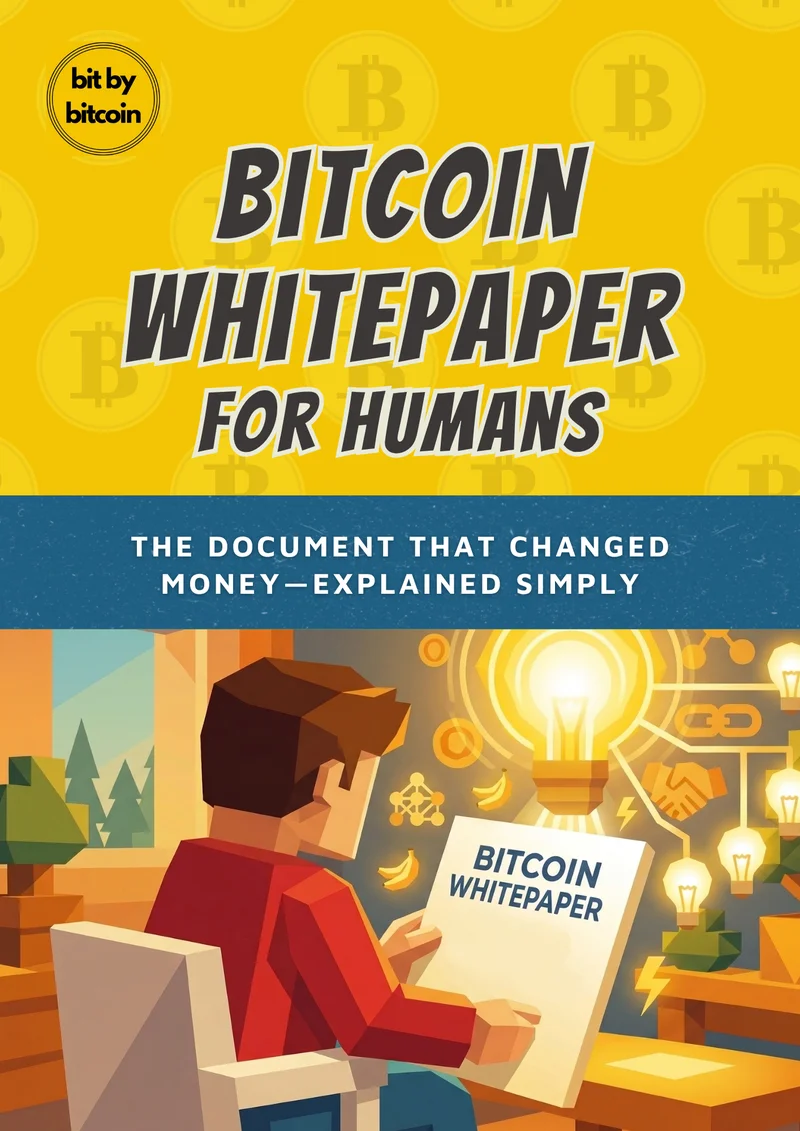
365 days to understanding Bitcoin. One concept per morning. In the right order.
The first thirty days don’t mention Bitcoin once.
That’s not an accident. Before Bitcoin makes sense, money has to make sense — what it is, how it breaks, and what happens when the people who control it start making decisions that benefit them more than everyone else. So this book starts there. Inflation. Fractional reserve banking. Why 1971 matters. The Cantillon Effect. By the time Bitcoin appears on Day 31, the reader already understands why something like it needed to exist.
From there, the book moves in nine parts — each one building on the last. What Bitcoin is. How to hold it safely. The real history, from the $0.0008 first trade to Cyprus and Mt. Gox. How the protocol works. Strategy. Sovereignty. Nothing arrives before the reader is ready for it.
Each day is 300 words. One concept. Short enough to read before the coffee gets cold.
This Book Is For You If…
- Bitcoin makes sense in theory but the full picture hasn’t clicked yet
- Daily, short-form learning sticks better than one long sitting
- The history and the mechanics interest you, not just the price
- A complete Bitcoin education — foundations to sovereignty — is the goal
- The idea of building understanding over a year, rather than rushing it, appeals
📖 Free Sample: Days 91–94
Part 4 covers Bitcoin’s real history — the founding moments that shaped everything that came after. By this point in the book, the reader already understands money, what Bitcoin is, and how to hold it safely. Now the story arrives.
Day 91 — The First Bitcoin Price
Subject: The first Bitcoin price was $0.0008. Let that sink in.
On October 12, 2009 — nine months after the Genesis Block — Bitcoin was traded for the first time.
The price: $0.0008 per coin. Not a penny. Not a fraction of a penny. Less than a tenth of a cent.
A Finnish developer named Martti Malmi sold 5,050 Bitcoin to someone called NewLibertyStandard for $5.02 via PayPal. The entire Bitcoin supply that existed at that moment was worth roughly the same as a cheap sandwich.
Neither of them knew what they were holding.
The price had been calculated by dividing the cost of electricity used to mine the coins by the number of coins produced. It was a curiosity. A proof of concept. Something a small circle of cypherpunks and cryptography enthusiasts played with in their spare time.
At that first price, one million Bitcoin — roughly what Satoshi holds — was worth $800.
This isn’t a story about getting rich. Most of the people who held Bitcoin at that price sold long before it reached anything meaningful. The ones who held through a decade of volatility, ridicule, crashes, and multiple declarations of death — they’re a different story entirely.
But the number itself tells you something. Every technology that eventually changes the world starts somewhere laughably small. The internet was once a curiosity used by academics. Email was considered a toy.
Something that costs $0.0008 and becomes $100,000 — that tells you something about what the world eventually decides matters.
Tomorrow: the pizza that changed everything.
Day 92 — Bitcoin Pizza Day
Subject: He paid 10,000 Bitcoin for two pizzas. Here’s the full story.
May 22, 2010. Laszlo Hanyecz, a Florida programmer and one of Bitcoin’s earliest miners, posted on the Bitcoin forum: “I’ll pay 10,000 Bitcoin for a couple of pizzas.”
At the time, 10,000 Bitcoin was worth roughly $41. Someone took him up on it, ordered two Papa John’s pizzas, and had them delivered to Laszlo’s door.
At today’s prices, those two pizzas would be worth hundreds of millions of dollars.
Every May 22, the Bitcoin community celebrates Bitcoin Pizza Day. Not as a joke about Laszlo’s bad trade — he’s said he doesn’t regret it — but as a commemoration of the first real-world Bitcoin transaction.
Laszlo wasn’t stupid. He was pioneering. He spent Bitcoin when spending Bitcoin meant something. He contributed to proving that the network worked, that the coins had real-world utility, that this wasn’t just a game.
The pizza story gets told as a punchline. But it’s really a founding moment — the day Bitcoin became money in the most practical sense. Someone wanted something, someone had Bitcoin, and a trade was made.
Every financial system in history started with a transaction exactly like this one.
Tomorrow: the Silk Road — and what it proved about Bitcoin that nobody expected.
Day 94 — The First Crash
Subject: Bitcoin hit $32. Then dropped to $2. In three months.
In June 2011, Bitcoin hit $32 for the first time — a price that felt extraordinary to the small community that had been watching it grow from fractions of a cent.
By November, it was $2.
The headlines were brutal. Bitcoin was declared dead — for the first time, but far from the last. Journalists wrote obituaries. The community scattered. Many early holders sold at a loss and walked away.
But something interesting happened next. A smaller group didn’t sell. They bought more. They read the code, ran the nodes, and kept the network alive through what felt like an extinction event.
By 2013, Bitcoin was at $1,000.
This pattern — dramatic crash, declared dead, quiet recovery, new high — has repeated in every major Bitcoin cycle. 2013, 2017, 2018, 2022. Each crash felt final. Each recovery surprised the people who had left.
The 2011 crash taught the Bitcoin community something it needed to learn early: price is not the same as value. The network kept running at $2 exactly as it had at $32. The code didn’t care about the price.
That distinction — between price and network — is the foundation of long-term Bitcoin thinking.
Tomorrow: who were the early adopters? What did they actually see?
Enjoying the sample? There’s plenty more where that came from.Get the first month — free →What the Nine Parts Cover
- Money Foundation — What money is, how paper money works, inflation, and why 1971 changed everything. Days 1–30.
- What Bitcoin Is — Where it came from, what problem it solves, and what makes it different from everything before it. Days 31–60.
- Getting Started — Wallets, keys, seed phrases, buying, sending. The practical layer, no computer science degree required. Days 61–90.
- History and Stories — The real events: the $0.0008 first trade, Bitcoin Pizza Day, the Silk Road, Mt. Gox, Cyprus. Days 91–120.
- Security and Self-Custody — Hardware wallets, multisig, the decisions that actually matter. Days 121–150.
- How Bitcoin Works — Mining, nodes, the blockchain, proof of work. Under the hood, in plain English. Days 151–180.
- More History — El Salvador, FTX, the 2017 run, governments that tried to ban it. Days 181–240.
- Strategy and Mindset — Cycles, volatility, long-term thinking, how to talk to skeptics. Days 241–300.
- Sovereignty and What Comes Next — CBDCs, institutional adoption, financial sovereignty, what a Bitcoin-standard world might look like. Days 301–365.
Three hundred words a morning. By Day 365, the whole picture is there.
Get the first month free.
No card, no catch — delivered to your inbox instantly.
Prefer to own the whole book?