
💡 The Plain-English Definition
An all-time high is the highest price Bitcoin has ever reached. It’s the peak — the point beyond which the price has never gone, until the next time it does.
🤔 But Why Though?
The all-time high isn’t just a trivia stat. In Bitcoin’s history, it has worked as a surprisingly meaningful signal — both psychologically and structurally.
Psychologically, the ATH is where fear turns to euphoria. When Bitcoin nears or breaks its previous all-time high, media coverage spikes, new buyers flood in, and holders who’ve been in the red for months or years finally see a profit. That flood of attention and emotion is exactly when markets are most dangerous — it’s when the most optimistic price predictions get published, and often when the most inexperienced buyers arrive at the worst possible moment.
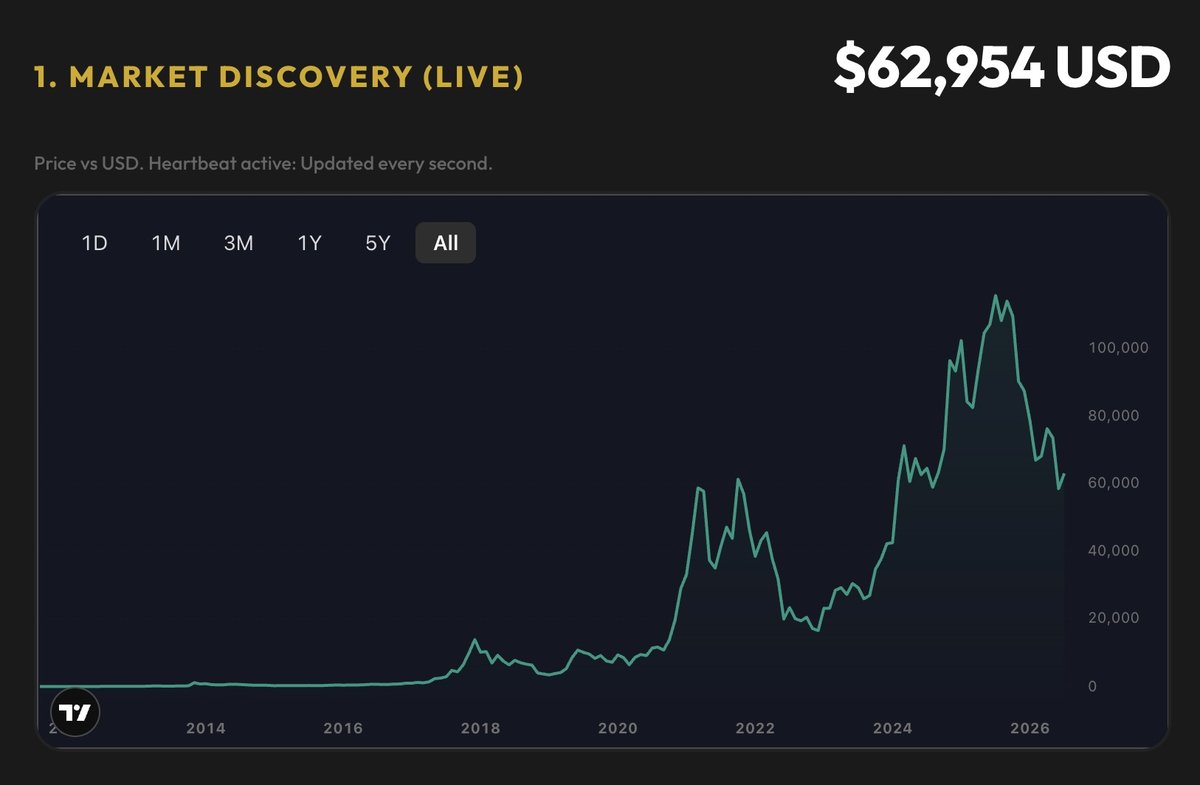
Structurally, Bitcoin’s four-year cycle has shown a consistent pattern: each cycle’s all-time high eventually becomes the floor of the next. Bitcoin hit roughly $1,000 in 2013, then crashed — but bottomed out in later cycles well above $1,000. It hit roughly $20,000 in 2017, then crashed — but the next cycle’s low was still above $20,000. The same pattern held through the 2021 high and the 2022 bear market. It’s not a guarantee — past patterns don’t write future laws — but it explains why long-term holders treat each ATH not as the top, but as a way station.
🌍 The Real-World Analogy
Think of climbing a mountain range, not a single peak. Each mountain you summit feels like the top — until you see the next one. Bitcoin’s all-time highs are those summits: at each one, it looks like the journey is over. From the base of the next valley (the bear market), the previous summit is still visible behind you, and the next is somewhere ahead in the mist. The people who stay on the mountain through the valley tend to reach the next summit. The people who go home after the first one don’t.
⚡ So What?
Understanding the ATH as a psychological and structural signal — rather than just a number — changes how you behave around it. Near an all-time high, the right questions are: Has my investment thesis changed, or just the price? Is my position size still right for my risk tolerance? Am I deciding based on understanding or excitement? A DCA (Dollar-Cost Averaging — buying a fixed amount on a regular schedule regardless of price) strategy sidesteps the ATH trap automatically — you’re not trying to time the top, because you’re buying steadily either way. The most expensive mistake most Bitcoin investors make is buying heavily near an ATH because the excitement felt like a signal. More often, it’s noise.