
💡 The Plain-English Definition
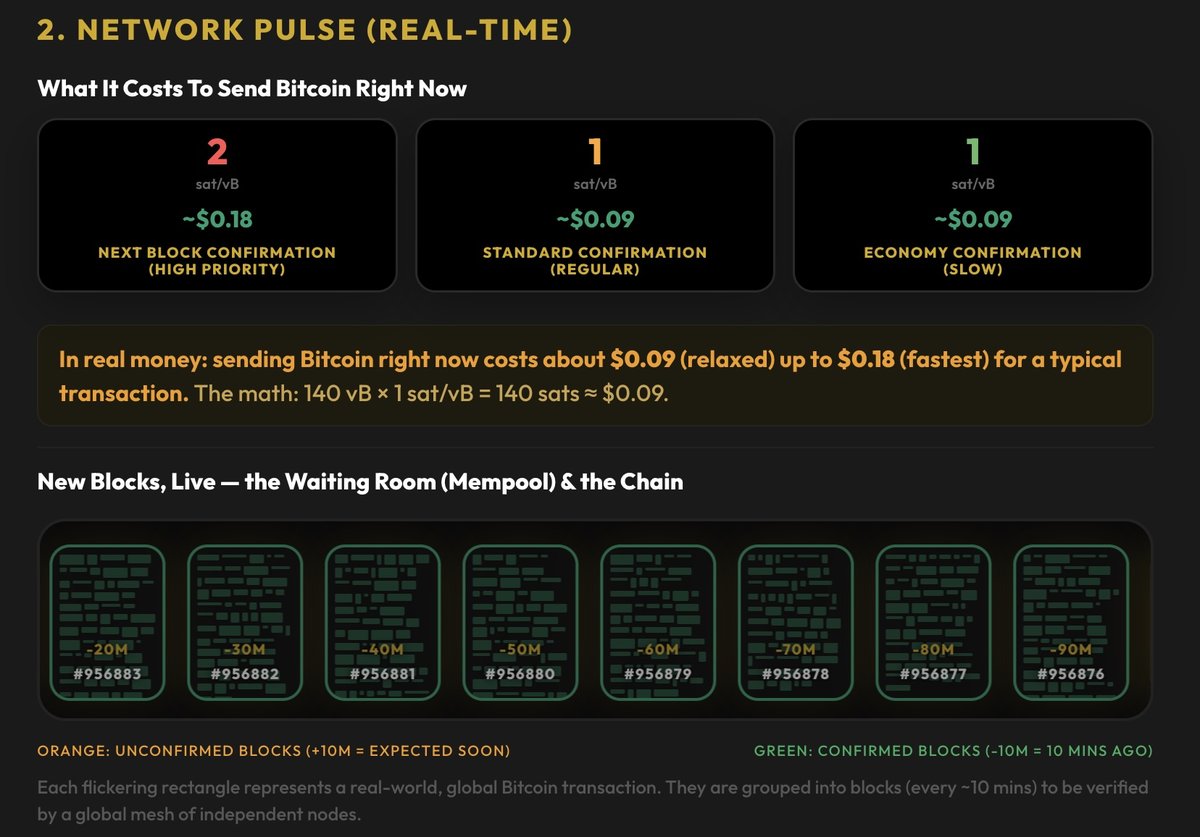
The mempool — short for memory pool — is the waiting room where unconfirmed Bitcoin transactions sit until a miner includes them in a block. Every full node — a computer that independently runs and validates the blockchain — keeps its own mempool, and when blocks fill up, the competition for space drives fees higher.
🤔 But Why Though?
When you broadcast a Bitcoin transaction, it doesn’t go straight into a block — it enters the mempool first and waits to be picked up by a miner. Miners scan the mempool and choose which transactions to put in the next block they’re building. Since each block has a fixed size limit (about 4 million weight units of data) and thousands of transactions may be waiting, miners rationally pick the ones with the highest feerate — the fee per unit of transaction size, in satoshis per virtual byte — to earn the most per block.
A key detail: every full node keeps its own independent mempool. There’s no single global mempool — it’s a scattered set of overlapping lists, each node holding the transactions it has seen and considers valid under its own rules. Most nodes run Bitcoin Core’s default settings, so the lists largely overlap, but they’re never identical. That matters when a transaction is in some mempools but not others, or when low-feerate transactions get dropped by nodes with stricter minimum-fee rules.
Once you picture that structure, congestion makes sense. When many transactions compete for limited block space, users have to bid higher feerates to confirm promptly. That’s why fees spike during bull markets (everyone transacting at once), after Ordinals or Runes activity (on-chain data eating block space), or during exchange outflows (everyone withdrawing together). When the mempool is quiet, even low-feerate transactions confirm quickly, because miners have spare space to fill.
A “pending” transaction is just one sitting in the mempool, waiting its turn — not broken, not lost, simply waiting for a miner to include it.
🌍 The Real-World Analogy
The mempool is like the queue at a busy post office on the last posting day before Christmas. Hundreds of packages wait. The staff (miners) work through them in order of priority — but unlike a fair queue, priority is set by how much extra you paid for express delivery (the feerate). Whoever paid for overnight shipping gets handled first, no matter when they arrived, while someone on standard delivery might wait for hours. And if the queue gets too long, the post office stops accepting new packages below a minimum postage.
⚡ So What?
Understanding the mempool explains fee behaviour and helps you make smarter fee decisions. Check mempool.space before sending a large transaction — it shows current congestion and fee estimates in real time. For anything non-urgent, sending during a quiet period (often weekends, or calm market stretches) can save a lot on fees. And if you underpay on something urgent, RBF (Replace-By-Fee, replacing a stuck transaction with a higher-fee version) and CPFP (Child Pays For Parent, creating a new high-fee transaction that pulls a stuck one through) are your tools.